
 EN
EN
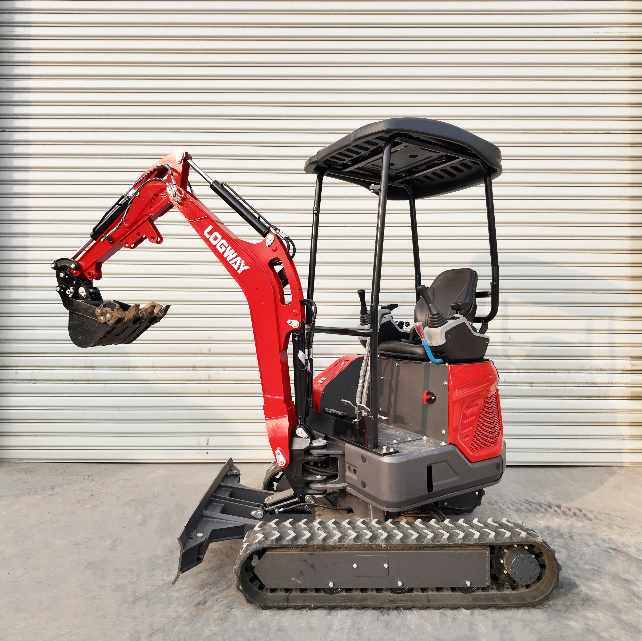
Zero-Tail Swing and Physical Envelope: Core Capabilities of a 2 Ton Excavator
How zero-tail swing enables safe operation within 60 cm of walls or utilities
Zero-tail-swing (ZTS) technology allows a 2 ton excavator to rotate 360° entirely within its undercarriage width—eliminating rear overhang that typically demands 1.2–1.5 m of clearance in conventional models. This makes it possible to work safely within just 60 cm of retaining walls, building foundations, or buried utilities. According to the International Council for Compact Equipment (ICCE) 2023 report, ZTS-equipped machines reduce property damage incidents by 78% on confined urban sites. The compact hydraulic system—featuring proportional control valves—delivers ±2 cm bucket positioning accuracy, critical when trenching near gas lines or fiber optic conduits. As a result, operators can execute foundation-parallel excavation without manual rework, cutting project timelines by up to 30% in alleyway repairs and similar constrained applications.
Measuring real-world swing radius vs. marketing claims: when 'zero-tail' overpromises
“True zero-tail” is a common marketing claim—but real-world performance varies. A 2024 Equipment Manufacturers Institute (EMI) audit found that 15% of tested 2 ton excavators exceeded their published swing radii by up to 8 cm when fitted with standard buckets, primarily due to auxiliary hydraulic lines or quick-coupler hardware extending beyond the undercarriage. In sub-65 cm clearance zones—such as historic districts or utility corridors—even a 3 cm deviation risks damaging masonry or underground infrastructure. Sloped terrain further complicates matters: track deflection on inclines can increase effective tail swing by 12–18%, meaning operators should apply a 10% buffer beyond factory-specified clearances for reliable obstacle-free rotation. Laser distance measurers are recommended for site-specific verification before work begins.
Site Access Realities: Gate, Doorway, and Interior Clearance for a 2 Ton Excavator
Minimum gate width (75 cm) and tracked undercarriage constraints per leading manufacturers
A 2 ton excavator’s access to tight sites hinges on precise dimensional planning. Leading manufacturers specify a minimum gate width of 75 cm—tight enough for most residential driveways and service alleys, yet wide enough to accommodate the machine’s tracked undercarriage without compromising stability. While tracks enhance traction and load distribution, they limit pivoting agility in spaces narrower than 1 meter. Operators must confirm both width and height clearances, assess weight-bearing capacity of surfaces like pavers or interior flooring, and verify swing envelope before entry. Typical models under 5 feet wide support backyard landscaping, septic installations, and utility upgrades—provided access points are measured accurately and structural integrity is confirmed in advance.
Indoor entry challenges: why partial disassembly is often required despite compact footprint
Despite its compact footprint, a 2 ton excavator rarely enters buildings fully assembled. Low-ceiling passages—especially those under 2 meters—commonly require partial disassembly: counterweights may be removed, booms folded, or even cab roofs unbolted. These steps add setup time but are essential to avoid ceiling contact or doorframe damage during basement renovations or interior demolition. Confined corridors demand hydraulic precision to prevent accidental wall contact; operators routinely use bucket-first entry techniques to probe clearance before committing the undercarriage. “Compact” does not equate to “effortless” indoors—realistic pre-job planning, including doorway height checks and interior turning radius assessments, prevents costly delays and protects sensitive environments.
2 Ton Excavator vs. 1 Ton: Accessibility Trade-Offs and Application Fit
When selecting equipment for confined sites, the choice between 1-ton and 2-ton excavators reflects a deliberate trade-off between maneuverability and capability. While 1-ton models can pass through gates under 1 meter with minimal disassembly—and excel in ultra-restricted settings like narrow alleyways or basement retrofits—their smaller hydraulic systems constrain breakout force and lift capacity. In contrast, 2-ton excavators typically require 75 cm of gate clearance but deliver 40–60% greater lifting power and bucket breakout force, per industry performance benchmarks. This expanded capability supports deeper trenching, heavier material handling, and more robust foundation prep. For projects demanding both spatial agility and moderate power—such as urban landscaping, small-scale utility installation, or controlled interior demolition—the 2-ton class delivers the optimal balance. Contractors should prioritize size only where absolute access limits override functional requirements.
Optimizing Tight-Space Performance: Precision Operating Techniques for a 2 Ton Excavator
Bucket-first entry, pivot-and-sweep maneuvers, and hydraulic fine-control settings
Precision technique—not just machine specs—defines success in tight-space operation. Start every confined-site entry with bucket-first sequencing: extend and position the bucket ahead of the undercarriage to scan the full path for obstructions before committing track movement. For repositioning within tight envelopes—like basement corners or utility trenches—use controlled pivot-and-sweep maneuvers: lock the tracks and rotate the upper structure, allowing the boom to sweep debris cleanly within a minimal arc while maintaining track stability. To avoid overshoot near sensitive infrastructure, engage hydraulic fine-control settings, which reduce flow by 30–50% and enable millimeter-level bucket placement. These techniques, combined with ZTS capability and verified site clearance, transform spatial constraints into operational advantages—without sacrificing safety or precision.
FAQ Section
What is Zero-Tail Swing technology?
Zero-Tail Swing technology allows an excavator to rotate 360 degrees within its undercarriage width without additional rear overhang, enabling safe operation near walls or utilities.
How does zero-tail swing contribute to site safety?
Zero-tail swing reduces property damage incidents by allowing excavators to operate closer to obstacles without risk, as reported by the ICCE.
Why might a 2 ton excavator exceed stated swing radii?
Real-world performance may vary due to auxiliary hydraulic lines or hardware protrusions that extend beyond the undercarriage, affecting swing radius.
What are typical measured site access points for a 2 ton excavator?
Typical access requires gate widths of at least 75 cm, and considerations for undercarriage constraints and structural integrity are essential.
Why is partial disassembly often required indoors?
Partial disassembly is typically required to navigate low-ceiling passages and prevent damage during indoor entry.
How does a 2-ton excavator compare to a 1-ton model?
A 2-ton excavator offers greater lifting and breakout force than a 1-ton model but requires larger access points like wider gates.
What precision operating techniques enhance performance in tight spaces?
Techniques such as bucket-first entry, pivot-and-sweep maneuvers, and hydraulic fine-control settings optimize tight-space performance.
Table of Contents
- Zero-Tail Swing and Physical Envelope: Core Capabilities of a 2 Ton Excavator
- Site Access Realities: Gate, Doorway, and Interior Clearance for a 2 Ton Excavator
- 2 Ton Excavator vs. 1 Ton: Accessibility Trade-Offs and Application Fit
- Optimizing Tight-Space Performance: Precision Operating Techniques for a 2 Ton Excavator
-
FAQ Section
- What is Zero-Tail Swing technology?
- How does zero-tail swing contribute to site safety?
- Why might a 2 ton excavator exceed stated swing radii?
- What are typical measured site access points for a 2 ton excavator?
- Why is partial disassembly often required indoors?
- How does a 2-ton excavator compare to a 1-ton model?
- What precision operating techniques enhance performance in tight spaces?