
 EN
EN
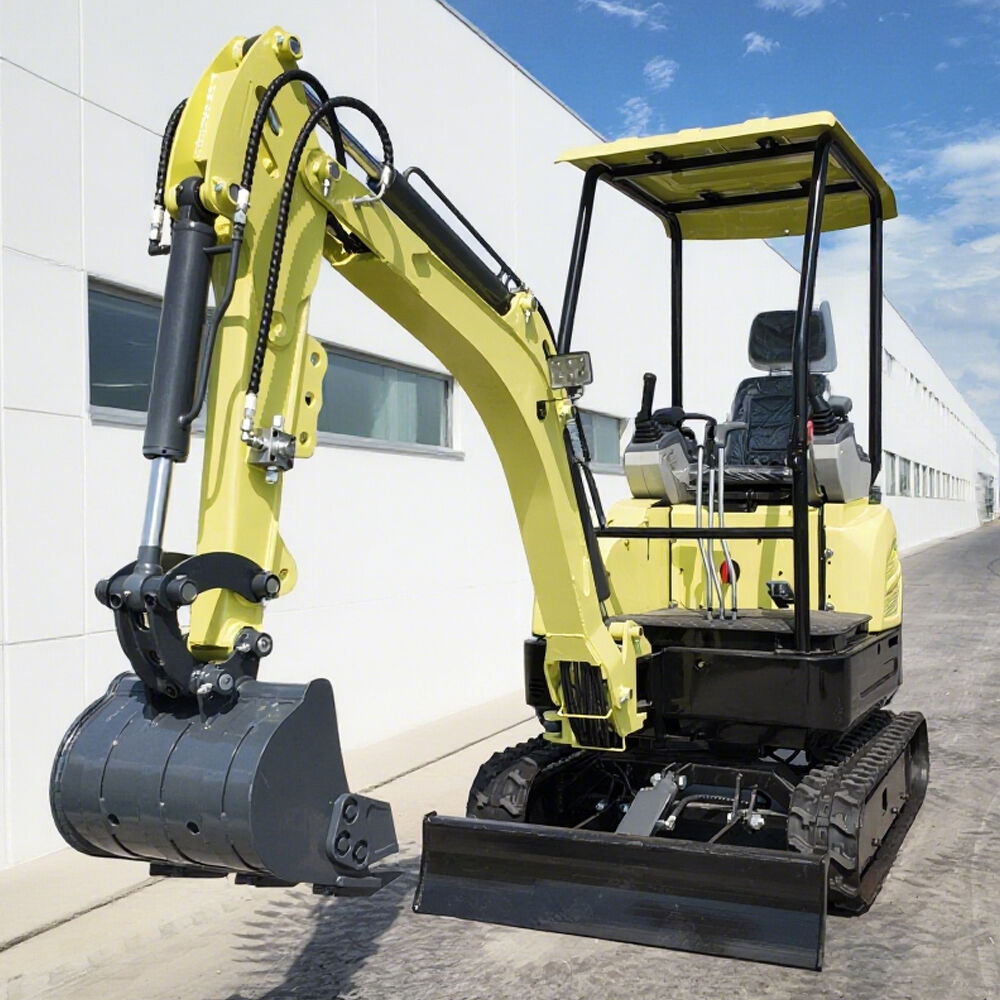
Urban and Confined Site Operations for the 2 Ton Excavator
Spatial Constraints in Dense Urban Environments
Urban construction demands equipment that navigates rigid spatial limitations. Over 71% of contractors report dimensional barriers when operating in cities (Construction Equipment Report 2023), where alleyways, basement entries, and building-adjacent sites restrict conventional machinery. The 2 ton excavator’s sub-3-foot width and under-6-foot height enable access through standard 6-foot gate openings—critical for underground utility repairs beneath sidewalks. With low ground pressure (<4.5 psi), it minimizes surface disruption and eliminates 40% of site prep delays caused by access modifications.
Zero-Tail Swing and Compact Dimensions Enable Gate-and-Backyard Access
Zero-tail-swing (ZTS) configuration allows full 360° rotation within an 8-foot diameter—eliminating collision risks with walls, fences, or overhead utilities. Combined with a foldable Rollover Protective Structure (ROPS), this design supports safe operation in backyards, courtyards, and indoor commercial spaces. Unlike larger excavators requiring 15–20 feet of clearance, these compact models maintain ground pressure between 0.5–1.5 psi, drastically reducing turf damage. Their trailer transportability also resolves logistical challenges for sites lacking direct equipment entry.
Residential Renovations and Light Commercial Excavation with a 2 Ton Excavator
Precision Digging for Footings, Utility Trenches, and Pool Shells
The 2 ton excavator delivers ±1-inch accuracy in tight residential settings—ideal for foundation footings, utility trenches as narrow as 12 inches, and pool shell excavation. Its hydraulic responsiveness enables controlled grading in sandy or unstable soils, significantly reducing collapse risk. Key applications include:
- Basement excavation completed 30–40% faster than manual labor
- Electrical conduit trenching at 50–70 feet/hour in compact soils
- Retaining wall base preparation on slopes under 15 degrees
Optimizing Bucket Capacity (0.05–0.08 m³) for Small-Scale Projects
Bucket selection directly impacts efficiency across light commercial tasks. Smaller 0.05 m³ buckets excel in delicate work like garden bed prep or tree root ball removal, while 0.08 m³ configurations handle driveway grading at up to 1.5 tons/hour. The optimal match between bucket size and task is summarized below:
| Bucket Size | Ideal Application | Efficiency Metric |
|---|---|---|
| 0.05 m³ | Tree root ball excavation | 98% soil retention rate |
| 0.07 m³ | Patio base gravel spreading | 40% faster than wheelbarrows |
| 0.08 m³ | Shallow foundation backfilling | 12 CY/hour output |
At just 2–3 tons, the machine avoids soil compaction in sensitive zones—including utility easements and historic property renovations—while reducing turf damage by 60% compared to skid steers during landscaping retrofits.
Landscaping, Hardscaping, and Boulder Handling Using a 2 Ton Excavator
Minimizing Turf Disruption in High-Value Outdoor Living Spaces
With ground pressure under 4 psi—lighter than an adult human—the 2 ton excavator preserves irrigation systems, mature plantings, and premium lawns during pool installations or retaining wall builds. Integrated laser-guided grading achieves ±0.5" tolerances, cutting manual rework by 92% in garden renovations. Narrow rubber tracks distribute weight evenly, enabling zero-turn maneuvers between ornamental trees without root damage—essential when reshaping terraces or installing permeable pavers adjacent to existing hardscapes.
Hydraulic Thumb vs. Mechanical Grab: Performance on Gentle Slopes (<15°)
On gentle inclines, hydraulic thumbs outperform mechanical grabs by offering real-time grip modulation—critical for securing irregular boulders on 10°–15° gradients and preventing rollaways. Mechanical grabs require flat staging areas, adding 30% to site prep time. Hydraulic systems maintain full 360° rotation while lifting up to 800 lbs, enabling precise rock placement near retaining walls. Operators report 40% faster placement cycles due to responsive pressure control during contouring.
Utility Installation and Underground Repairs in Sensitive Urban Areas
For utility installations in dense cities, the 2 ton excavator excels where precision and minimal footprint are non-negotiable. Its compact dimensions allow navigation through narrow alleys and historic districts, while its fine hydraulic control enables trenching within inches of existing infrastructure—reducing risks of gas leaks, fiber-optic cuts, or service interruptions. In scenic or heritage zones, limited ground disturbance preserves visual integrity and avoids costly restoration. These capabilities make the 2 ton excavator indispensable for urban utility upgrades where space, safety, and stakeholder expectations converge.
FAQs
What makes the 2 ton excavator suitable for urban construction?
Its compact size, zero-tail-swing configuration, and low ground pressure enable it to navigate tight spaces while minimizing surface disruption in urban environments.
Can a 2 ton excavator handle backyard projects?
Yes, its compact dimensions and zero-tail-swing design make it ideal for backyard projects, including grading, trenching, and small-scale landscaping tasks.
What types of applications are best suited for this excavator?
It is well-suited for residential renovations, light commercial excavation, landscaping, boulder handling, and utility installations in confined spaces.
How does it minimize turf damage?
Its low ground pressure (under 4 psi) and rubber tracks distribute weight evenly, reducing turf damage during operation.
What are the benefits of hydraulic thumbs over mechanical grabs?
Hydraulic thumbs provide real-time grip modulation, offering superior control for placing irregular objects on slopes and reducing site prep time.