
 EN
EN
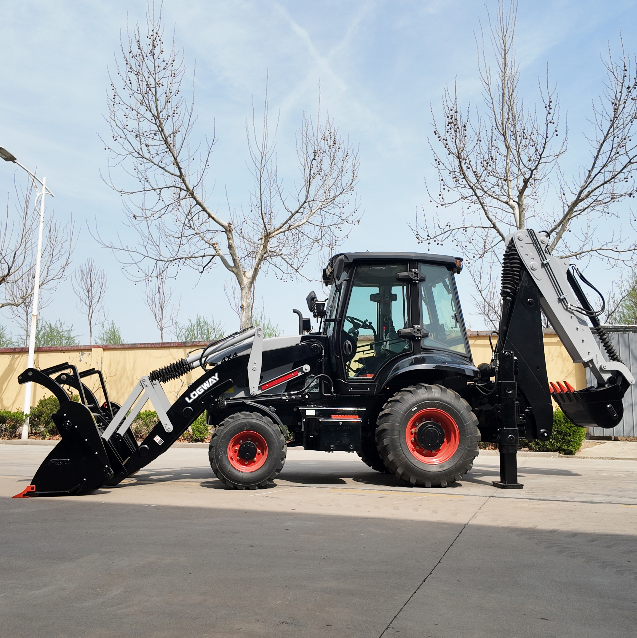
Excavation and Trenching: The Core Strength of the Backhoe Loader
Trenching for Foundations, Footings, and Drainage Systems
The backhoe loader excels in creating precise trenches for critical construction elements. Its rear-mounted hydraulic arm efficiently digs trenches for building foundations, concrete footings, and underground drainage systems. Operators leverage the machine’s compact footprint to work in confined urban sites or around existing structures where larger equipment can’t maneuver—minimizing disruption while maintaining excavation accuracy. The integrated front loader simultaneously handles spoil removal, accelerating project timelines by eliminating the need for separate material-handling equipment.
Why Backhoe Loaders Dominate Mid-Depth Excavation (0.5–4.5 m)
Within the 0.5–4.5 meter depth range—covering most utility installations and shallow foundations—backhoe loaders outperform both manual labor and larger excavators. Their optimal power-to-size ratio delivers faster cycle times than full-size excavators for trenches under 4.5 m deep, reducing project costs by up to 30% according to equipment efficiency benchmarks. Key advantages include:
- Mobility: Quick repositioning between trench segments without auxiliary transport
- Versatility: Immediate transition from digging to loading or backfilling
- Cost-Efficiency: Lower ownership and operational costs versus dedicated excavators
This makes them indispensable for water/sewer lines, electrical conduits, and irrigation projects where depth and space constraints align with their operational sweet spot.
Utility and Infrastructure Installation: Backhoe Loader Versatility in Action
Urban vs. Rural Utility Deployment: Compact Maneuverability and Minimal Site Disruption
The backhoe loader excels across diverse settings due to its dual-function design. In dense urban environments, its compact footprint—typically under 3 m wide—enables navigation through narrow streets and alleys where larger excavators cannot operate. Operators use this maneuverability to install water pipes, fiber-optic cables, or gas lines with minimal disruption to traffic and adjacent infrastructure—critical in cities where space constraints increase project costs by 15–30% (Construction Efficiency Report 2023).
In rural areas, the same unit that digs trenches for drainage systems can switch attachments to handle materials or perform light grading—reducing equipment needs in remote locations. This multifunctionality cuts mobilization costs by up to 40% compared to specialized machinery, while its 0.5–4.5 m digging range accommodates most utility depth requirements without requiring multiple machines.
Whether deploying sewer lines in crowded suburbs or laying electrical conduits across farmland, the backhoe loader balances precision with adaptability. Its ability to minimize ground disturbance preserves landscapes in sensitive areas, and quick attachment swaps—such as from auger to grapple—accelerate complex tasks like pole setting or debris clearance.
Road Construction and Maintenance: Grading, Paving Support, and Rapid Repairs
Backhoe Loader Roles in Subbase Preparation, Shoulder Work, and Patching
Backhoe loaders deliver essential versatility in road projects. Their dual functionality streamlines subbase preparation by efficiently spreading and compacting aggregate layers—creating stable foundations for asphalt or concrete surfaces. Operators achieve precise grading using the loader bucket while the rear excavator handles trenching for drainage.
For shoulder maintenance, the machine’s compact size allows work near active traffic lanes without full road closures. The loader quickly redistributes eroded material, while the backhoe reshapes embankments to maintain critical lateral support for pavement edges—a priority reflected in industry metrics like the Pavement Condition Index.
Patching operations benefit most from rapid deployment: crews remove damaged asphalt sections using the excavator arm, apply tack coats, fill holes with hot-mix material, and immediately compact using loader bucket pressure or integrated rollers. This single-machine approach reduces repair times by over 40% compared to multi-equipment teams (Roadway Maintenance Efficiency Study, 2022).
Material Handling and Site Cleanup: Underrated Backhoe Loader Functions
While excavation dominates discussions, the backhoe loader’s material handling and site cleanup capabilities deliver substantial efficiency gains. The front loader bucket excels at transporting debris, aggregate, or soil across job sites—a single operator can clear rubble after demolition or distribute gravel for backfilling. This versatility reduces equipment changes: rather than switching between excavators and dump trucks, crews use one machine for debris removal, material relocation, and rough grading. Minimizing machine swaps cuts rental costs and shortens project timelines. For confined urban sites, the backhoe loader’s compact footprint enables maneuvering around obstacles where larger equipment cannot operate—making it indispensable for final-phase cleanup before handover.
FAQ Section
What is the main advantage of using a backhoe loader for trenching?
The primary advantage is its precision in excavation due to its compact size and maneuverability, which allows operators to work in confined spaces while minimizing site disruption.
How does a backhoe loader save costs compared to larger excavators?
Backhoe loaders offer lower ownership and operational costs, faster cycle times for mid-depth trenches, and multifunctionality, which can reduce project costs by up to 30%.
Can a backhoe loader be used both in urban and rural settings?
Yes, its compact design allows effective operation in urban areas with narrow spaces and in rural settings, where it can switch attachments to perform various tasks, reducing equipment needs.
What makes backhoe loaders suitable for road maintenance?
Their versatility allows them to handle subbase preparation, shoulder work, and rapid patching repairs, all while maintaining efficiency and minimizing road closure times.
Why are backhoe loaders important for site cleanup?
They are essential due to their material handling capabilities, which reduce the need for multiple machines, cut costs, and shorten project timelines, especially in densely packed urban sites.
Table of Contents
- Excavation and Trenching: The Core Strength of the Backhoe Loader
- Utility and Infrastructure Installation: Backhoe Loader Versatility in Action
- Road Construction and Maintenance: Grading, Paving Support, and Rapid Repairs
- Material Handling and Site Cleanup: Underrated Backhoe Loader Functions
-
FAQ Section
- What is the main advantage of using a backhoe loader for trenching?
- How does a backhoe loader save costs compared to larger excavators?
- Can a backhoe loader be used both in urban and rural settings?
- What makes backhoe loaders suitable for road maintenance?
- Why are backhoe loaders important for site cleanup?